Jump to a question in this guide
- Why can the money needed to close exceed the down payment?
- How does the deposit count toward the purchase?
- Why is a mortgage commitment different from money available at closing?
- What does the statement of adjustments actually adjust?
- Which expenses belong outside the price calculation?
- How do new construction and shared property change the enquiry?
- Why do the dates matter as much as the totals?
- How should you verify instructions before moving large sums?
- What can you check when two funds statements disagree?
- How does one fictional purchase reconcile from price to buyer funds?
- Which professional answers each unresolved question?
- What belongs in the final closing and possession record?
- Credit earlier money once and reconcile the actual usable advance with the adjusted price.
- Separate legal closing charges, already paid investigations and post-possession reserves.
- Confirm current documents, deadlines and payment instructions through the responsible professionals.
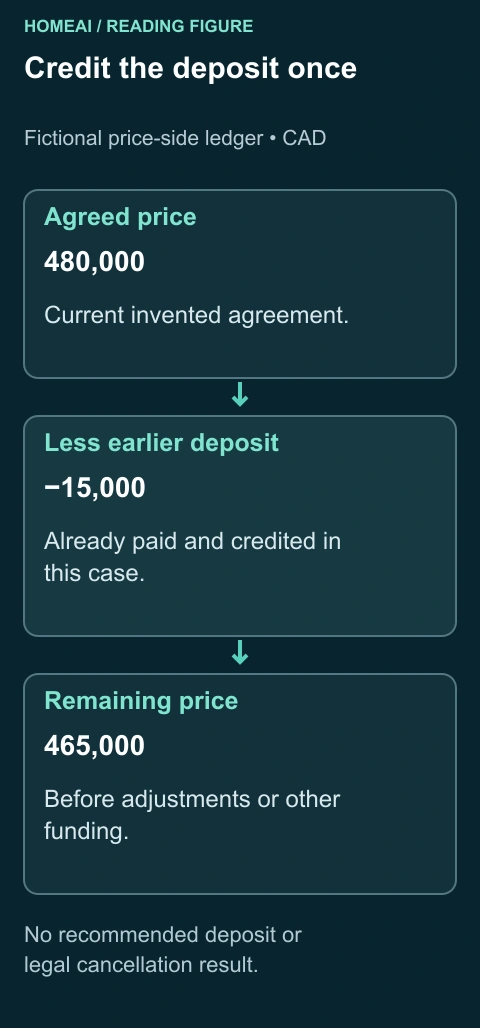
The invented CAD 15,000 deposit reduces the CAD 480,000 price-side balance to CAD 465,000. It is counted as earlier money, rather than charged again as an extra cost.
About this illustration
No actual receipt, trust allocation, contract credit, cancellation entitlement or standard deposit is supplied. This is a conceptual teaching model, not an assessment of your home.
6 picture lessons appear beside the questions in this guide. Use them to understand the explanation, then consider what it means for your home.
Why can the money needed to close exceed the down payment?
Closing turns a purchase agreement and financing arrangement into the actual exchange of money and property rights. The buyer contributes funds, a lender may release an advance, the earlier deposit is accounted for, and the legal professional settles the amounts required for the transaction. The cash still needed is the result of that reconciliation, not simply the down payment repeated on a new page.
Separate three totals at the start. The purchase price is the agreed property price. The buyer contribution toward that price includes a deposit where the contract gives that credit. Acquisition expenses and adjustments are additional identified items. Some have already been paid before closing, while others form part of the final funds request. Counting every category as a new closing payment can overstate the requirement; omitting one can leave a shortfall.
A rough percentage allowance can help early planning but cannot settle an actual transaction. Property type, province, municipality, borrowing, contract terms and service scope change the items. Ask for an itemized estimate early, then replace estimates with current instructions and final figures. A guide cannot calculate the legal amount for your purchase without those actual documents and advice.
This guide follows acquisition cash and its timing. The mortgage-structure guide explains principal, interest and contract flexibility. The first-year ownership guide covers recurring bills, maintenance and reserves after purchase. Keep all three connected: transferring enough money for closing does not demonstrate that the household retains enough for an immediate repair or the first months of ownership.
Use your lawyer or, where appropriate, notary as the contact for the legal closing reconciliation, and your lender or mortgage professional for the borrowing and advance. Ask who prepares each statement, which figures are provisional and when the final funds instructions will be available. A clear division of responsibilities makes a last-minute change easier to understand.
Three totals with different jobs
- Purchase priceAgreed property price under the current agreement.
- Remaining buyer fundsThe current reconciliation after credits, actual financing and included charges.
- Broader acquisition cashEarlier and later identified purchase expenses, each counted once.
The actual legal funds statement determines the transaction; no universal cost percentage is supplied.
Further reading: FCAC — Buying a home; CMHC — How much will my home really cost?; RECA — Home Buyer’s Guide, current consumer CDN copy.
How does the deposit count toward the purchase?
A deposit is money provided under the purchase contract before completion. Its amount, due date, recipient and holding terms come from that agreement. It commonly forms part of the buyer contribution toward the price. It is therefore important to credit it correctly at closing rather than treating it as an extra charge on top of the agreed price.
Suppose an invented contract has a CAD 480,000 price and a CAD 15,000 deposit already paid. Before considering other credits or adjustments, CAD 465,000 of the price remains to be accounted for. The CAD 15,000 does not vanish and should not be requested a second time as though nothing had been paid. This illustrates a credit only; it supplies no recommended deposit or standard percentage.
Keep the signed agreement, any amendments and the receipt or confirmation of the deposit. Ask the closing professional how the deposit will appear in the reconciliation and who will account for it. A screenshot showing money left your bank is not the same as confirmation that the correct recipient received and allocated it to the correct transaction.
Do not assume a familiar deposit amount carries familiar return or forfeiture conditions. Those issues depend on the actual contract and legal circumstances. If a condition, deadline or transaction problem arises, obtain advice before treating the deposit as freely available again. This guide does not give a legal result for cancellation, default or a disputed payment.
Additional deposits or negotiated credits deserve separate lines and original documents. A later amendment can change a calculation that was correct when the first estimate was prepared. Keep the chronology visible so the final statement reflects the accepted transaction rather than an earlier offer, a remembered conversation or a sum copied from an unrelated purchase.
Credit the deposit once
The invented CAD 15,000 deposit reduces the CAD 480,000 price-side balance to CAD 465,000. It is counted as earlier money, rather than charged again as an extra cost.
Numbers identify the parts explained below.
- Agreed price
480,000. Current invented agreement.
- Less earlier deposit
−15,000. Already paid and credited in this case.
- Remaining price
465,000. Before adjustments or other funding.
What does this illustration leave out?
No actual receipt, trust allocation, contract credit, cancellation entitlement or standard deposit is supplied. This illustration explains an idea. It is not an installation guide.
Where is the confirmed earlier deposit credited in the current reconciliation?
Explore this with HomeAI ↗Opens an editable question. Nothing is sent until you choose to send it.Read the complete figure
Credit the deposit once
Fictional price-side ledger • CAD
- Agreed price
- 480,000. Current invented agreement.
- Less earlier deposit
- −15,000. Already paid and credited in this case.
- Remaining price
- 465,000. Before adjustments or other funding.
No recommended deposit or legal cancellation result.
The invented CAD 15,000 deposit reduces the CAD 480,000 price-side balance to CAD 465,000. It is counted as earlier money, rather than charged again as an extra cost.
What remains unknown: No actual receipt, trust allocation, contract credit, cancellation entitlement or standard deposit is supplied.
A useful question: Where is the confirmed earlier deposit credited in the current reconciliation?
Why is a mortgage commitment different from money available at closing?
A mortgage commitment describes the lender’s proposed financing and its conditions. An advance is the actual release of money. Between them may be documents, property information and instructions requiring completion. RECA’s Alberta guide explains why a prequalification is not final property-specific financing and why a commitment can itself contain conditions. Ask the actual lender what remains outstanding.
Distinguish the stated gross loan from the amount available to settle the purchase. Ask for a written account of any financed charges, amounts paid separately and deductions, if any, affecting the release. Do not invent a standard lender deduction or assume every charge is subtracted. The documents must identify what applies to this loan.
The mortgage information box described by FCAC for federally regulated institutions identifies principal, advance timing, interest commencement, payment details and charges. It is useful for tracing borrowing, but it is not the complete closing statement. The legal professional must connect lender instructions with the agreed transaction and the funds they actually receive.
Inform the lender and adviser about relevant changes in financial circumstances and the purchase. Do not hide additional borrowing, a changed gift arrangement or an amended price to preserve an old estimate. A new debt can affect more than cash availability; it can change the lender’s assessment or instructions. Only the actual lender can confirm the consequences.
Ask when the advance is expected, what confirms release and who will notify you of an unresolved condition. A planning entry saying mortgage approved is too broad if the relevant completion documents or funding instructions remain open. Track those tasks specifically without claiming that the guide, an agent’s reassurance or a signed application guarantees funding.
Follow the actual usable advance
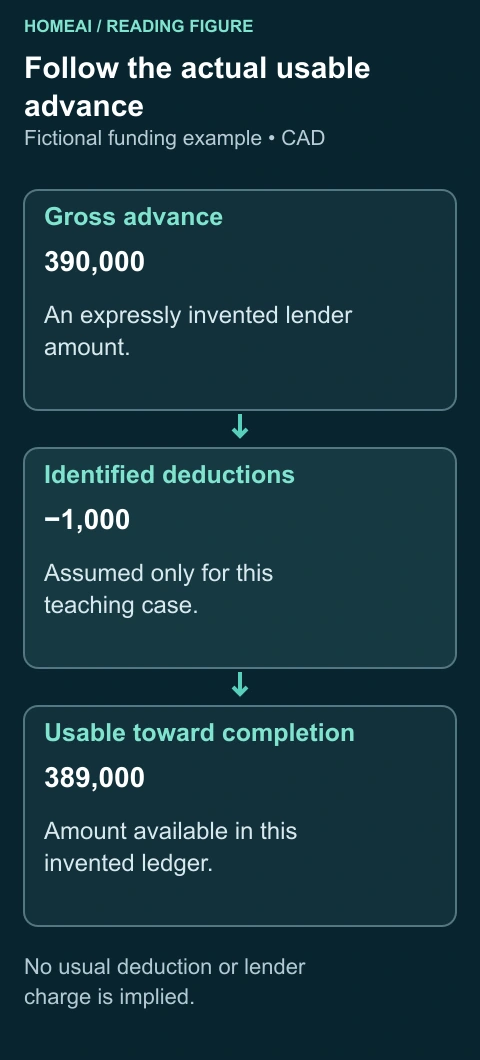
The diagram distinguishes an invented gross advance from its usable amount after an expressly assumed CAD 1,000 deduction. Actual documents must explain whether any such deduction exists and what it concerns.
Numbers identify the parts explained below.
- Gross advance
390,000. An expressly invented lender amount.
- Identified deductions
−1,000. Assumed only for this teaching case.
- Usable toward completion
389,000. Amount available in this invented ledger.
What does this illustration leave out?
The invented deduction has no claimed legal basis, fee category, prevalence or application to a real borrower. This illustration explains an idea. It is not an installation guide.
What actual documented treatment connects the gross loan with funds available at closing?
Explore this with HomeAI ↗Opens an editable question. Nothing is sent until you choose to send it.Read the complete figure
Follow the actual usable advance
Fictional funding example • CAD
- Gross advance
- 390,000. An expressly invented lender amount.
- Identified deductions
- −1,000. Assumed only for this teaching case.
- Usable toward completion
- 389,000. Amount available in this invented ledger.
No usual deduction or lender charge is implied.
The diagram distinguishes an invented gross advance from its usable amount after an expressly assumed CAD 1,000 deduction. Actual documents must explain whether any such deduction exists and what it concerns.
What remains unknown: The invented deduction has no claimed legal basis, fee category, prevalence or application to a real borrower.
A useful question: What actual documented treatment connects the gross loan with funds available at closing?
What does the statement of adjustments actually adjust?
An adjustment allocates an identified cost or credit between the parties according to the transaction. Prepaid property taxes are a familiar example: a seller may already have paid an amount covering time after the buyer takes possession. The reconciliation may require the buyer to reimburse the applicable share. The direction, period and calculation need the actual records and contract.
Start with the underlying bill or account, not the final number alone. Ask what was paid, which dates the payment covers and which date governs the allocation. An annual tax assessment, an annual bill and confirmation of payment answer different questions. A familiar tax amount does not establish whether the seller has already paid it.
Do not use one national daily formula. The applicable agreement, municipality’s billing arrangement and legal practice matter. RECA’s source concerns Alberta and CMHC lists prepaid expenses conceptually. Neither makes an online example a final calculation for every Canadian property. Have the professional explain the actual period and amount they used.
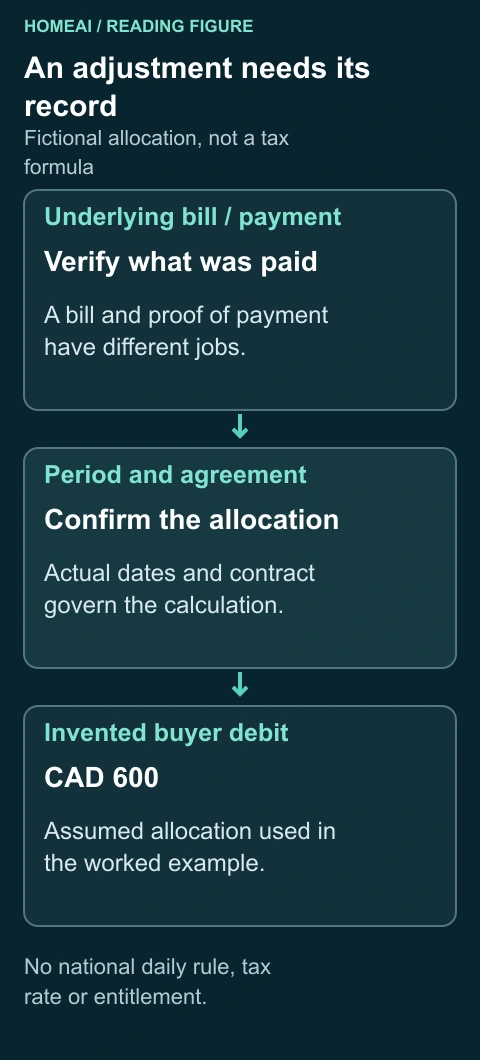
For a simple fictional illustration, suppose a verified prepaid item is allocated CAD 600 to the buyer’s period under the invented transaction. That CAD 600 is an additional buyer debit in the reconciliation. The illustration assumes that allocation rather than deriving it from a calendar. It is not a tax bill, rate, entitlement or instruction for assigning possession-day costs.
Read credits with the same care as debits. Ask whether an amount reduces what must be paid to the seller, reimburses an earlier payment or serves another documented purpose. A credit is not necessarily extra cash handed to the buyer. Keep each adjustment attached to its supporting document and explanation so its effect is understandable.
An adjustment needs its record
A prepaid adjustment begins with the underlying item and payment record, then the actual period and agreement. Only after that explanation does it become a debit or credit. CAD 600 is an invented assumed allocation.
Numbers identify the parts explained below.
- Underlying bill / payment
Verify what was paid. A bill and proof of payment have different jobs.
- Period and agreement
Confirm the allocation. Actual dates and contract govern the calculation.
- Invented buyer debit
CAD 600. Assumed allocation used in the worked example.
What does this illustration leave out?
No actual bill, payment, possession-day allocation, municipality rule or tax amount is supplied. This illustration explains an idea. It is not an installation guide.
Which record and period support the adjustment, and why is its direction a debit or credit?
Explore this with HomeAI ↗Opens an editable question. Nothing is sent until you choose to send it.Read the complete figure
An adjustment needs its record
Fictional allocation, not a tax formula
- Underlying bill / payment
- Verify what was paid. A bill and proof of payment have different jobs.
- Period and agreement
- Confirm the allocation. Actual dates and contract govern the calculation.
- Invented buyer debit
- CAD 600. Assumed allocation used in the worked example.
No national daily rule, tax rate or entitlement.
A prepaid adjustment begins with the underlying item and payment record, then the actual period and agreement. Only after that explanation does it become a debit or credit. CAD 600 is an invented assumed allocation.
What remains unknown: No actual bill, payment, possession-day allocation, municipality rule or tax amount is supplied.
A useful question: Which record and period support the adjustment, and why is its direction a debit or credit?
Which expenses belong outside the price calculation?
Legal fees pay for the agreed professional service. Disbursements are identified expenses incurred in carrying it out, such as an applicable search or registration cost. Ask for an itemized scope and estimate, including how taxes and third-party charges are treated. Two advertised service prices may cover different work, and an estimate can change if the actual transaction needs additional work.
Registration or transfer charges vary by jurisdiction and transaction. Do not copy a fee or land-transfer-tax calculation from another province. Ask the local professional to identify each applicable charge and the current official basis. This guide gives no national tax schedule or exemption result because location, property and buyer circumstances must be reconciled.
Property insurance, lender insurance and title insurance have different jobs. Ask what coverage is required, for whom, when it must begin and which premium is due. An owner’s title policy and a lender’s policy protect different interests under their terms. Insurance does not replace the technical investigation of a roof, foundation, sewer or other physical system.
Some investigation costs occur before closing: inspection, a scoped specialist assessment, valuation, survey-related work or property-specific water and septic enquiries. Check whether an item has already been paid and whether the final statement includes it. Paying early changes the date cash leaves, not the purpose of the cost. A receipt also does not enlarge the provider’s assessment scope.
Moving, service connections and immediate household purchases belong in the cash plan even when they are absent from the legal statement. Keep them outside the price reconciliation so the same amount is not counted twice. Carry maintenance and longer-term repair reserves into the first-year budget rather than describing every future expense as a closing fee.
Count each amount in its place
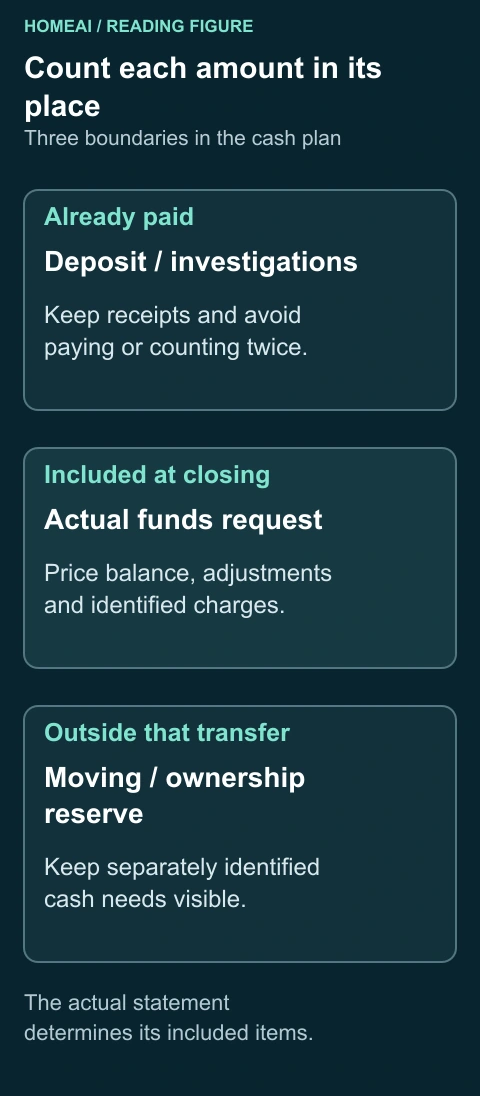
Earlier payments, the final transfer and cash retained outside it belong in separate parts of the plan. This prevents an already paid investigation from being counted again and prevents an ownership reserve from disappearing into the legal transfer.
Numbers identify the parts explained below.
- Already paid
Deposit / investigations. Keep receipts and avoid paying or counting twice.
- Included at closing
Actual funds request. Price balance, adjustments and identified charges.
- Outside that transfer
Moving / ownership reserve. Keep separately identified cash needs visible.
What does this illustration leave out?
No actual cost, legal account or recommended reserve amount is established. This illustration explains an idea. It is not an installation guide.
Has each actual expense been counted once, on the date and in the total where it belongs?
Explore this with HomeAI ↗Opens an editable question. Nothing is sent until you choose to send it.Read the complete figure
Count each amount in its place
Three boundaries in the cash plan
- Already paid
- Deposit / investigations. Keep receipts and avoid paying or counting twice.
- Included at closing
- Actual funds request. Price balance, adjustments and identified charges.
- Outside that transfer
- Moving / ownership reserve. Keep separately identified cash needs visible.
The actual statement determines its included items.
Earlier payments, the final transfer and cash retained outside it belong in separate parts of the plan. This prevents an already paid investigation from being counted again and prevents an ownership reserve from disappearing into the legal transfer.
What remains unknown: No actual cost, legal account or recommended reserve amount is established.
A useful question: Has each actual expense been counted once, on the date and in the total where it belongs?
How do new construction and shared property change the enquiry?
A new-build transaction can include contract items that differ from a straightforward resale. Ask the legal professional to identify adjustments, taxes, allowances, credits and completion obligations in the actual agreement. The existence of a rebate programme does not prove this buyer is eligible, that it is included in the price or that cash will arrive before closing.
Make the contract’s treatment of taxes and any claimed rebate explicit. Ask who applies, who receives a payment or credit and what happens if an assumption is not satisfied. Obtain current official programme reading and qualified tax advice for a material eligibility claim. This guide deliberately supplies no programme limit, promised refund or builder-specific conclusion.
Condominium or other shared-property purchases add document and account questions. Ask which current charges, prepaid amounts, special assessments or other obligations affect the closing reconciliation under the actual transaction. The relevant records and legal review must establish the answer. A monthly fee in a listing is not the entire financial picture.
Keep physical condition connected to shared obligations. A roof or drainage project may be a common-property decision rather than work the unit buyer can arrange alone. Read the established shared-property and records guides, then ask who controls the work and who funds it. An itemized closing amount cannot establish that the corporation’s future repair needs are fully financed.
The purpose is to identify the additional branch in the transaction before it becomes a surprise. Add a named question, responsible professional and expected response date to the closing plan. Preserve an unresolved item as unresolved; neither an optimistic estimate nor the absence of a line on an early worksheet proves no obligation exists.
Why do the dates matter as much as the totals?
A closing-funds plan is a dated sequence. The deposit may be required earlier, investigations may be paid during due diligence, buyer funds may need to reach the legal professional before completion, and moving or insurance payments have their own dates. A household can have enough overall assets while still lacking usable money at the required moment.
Ask the legal professional for the actual deadline, accepted payment method, recipient details and process for confirmation. Ask your financial institution about access to the particular savings or investment and processing times. Do not assume every account balance is immediately transferable or that a bank draft, transfer request and received usable funds are the same event.
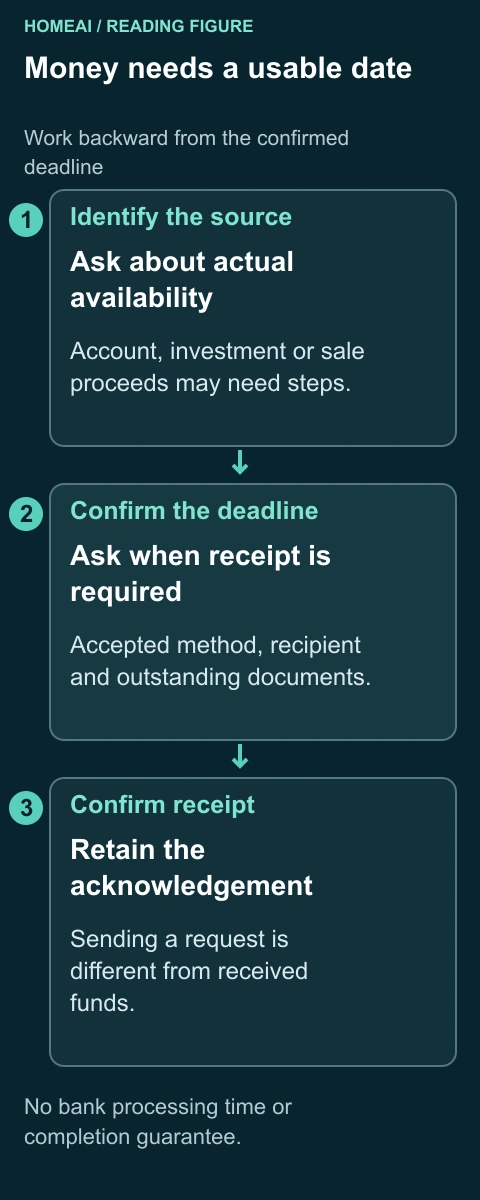
Work backward from the confirmed deadline. Identify any required sale of an investment, withdrawal request, document review or bank appointment, then allow the institution to explain the practical timing. If funds come from a property sale or another transaction, tell the advisers about both dates. Do not assume proceeds will be available merely because the sale is expected.
Bridging a gap requires an actual approved arrangement and its own costs and conditions. An expected family contribution likewise needs accurate disclosure and documentation of whether it is a gift or debt. This guide offers no bridge-loan approval or programme-withdrawal procedure. It teaches why the money’s source, usable date and lender acceptance must line up.
Keep a contingency for an unresolved timing problem by discussing it early with the relevant professionals. Do not independently alter a contractual date, hold back a payment or borrow secretly to conceal a shortfall. The response is a transaction decision requiring advice. A tidy timeline makes the question visible; it cannot guarantee that every institution or counterparty will perform on schedule.
Money needs a usable date
The enquiry moves from the source and its usable date to the professional’s actual receipt deadline, then confirmation. The order shows why a sufficient asset total can still leave an unresolved cash-timing problem.
Numbers identify the parts explained below.
- Identify the source
Ask about actual availability. Account, investment or sale proceeds may need steps.
- Confirm the deadline
Ask when receipt is required. Accepted method, recipient and outstanding documents.
- Confirm receipt
Retain the acknowledgement. Sending a request is different from received funds.
What does this illustration leave out?
No particular account liquidity, processing interval, bridging approval or transaction date is supplied. This illustration explains an idea. It is not an installation guide.
Can the documented source be usable and accepted by the actual required receipt time?
Explore this with HomeAI ↗Opens an editable question. Nothing is sent until you choose to send it.Read the complete figure
Money needs a usable date
Work backward from the confirmed deadline
- Identify the source
- Ask about actual availability. Account, investment or sale proceeds may need steps.
- Confirm the deadline
- Ask when receipt is required. Accepted method, recipient and outstanding documents.
- Confirm receipt
- Retain the acknowledgement. Sending a request is different from received funds.
No bank processing time or completion guarantee.
The enquiry moves from the source and its usable date to the professional’s actual receipt deadline, then confirmation. The order shows why a sufficient asset total can still leave an unresolved cash-timing problem.
What remains unknown: No particular account liquidity, processing interval, bridging approval or transaction date is supplied.
A useful question: Can the documented source be usable and accepted by the actual required receipt time?
How should you verify instructions before moving large sums?
The correct amount sent to the wrong recipient does not complete the intended funds plan. Treat payment instructions as a separate verification task. Establish the legal professional’s known contact channel at the beginning of the retainer and ask how instructions and changes are authenticated. A display name, logo or familiar email thread is not sufficient proof of the sender.
The Law Society of Alberta warning read for this guide describes a scam using a lawyer’s displayed name with a different sender address to request payment. Its audience is the legal profession, and it is not a complete consumer transfer standard. It nevertheless explains why a professional’s established payment-control process matters when a buyer receives urgent or changed instructions.
If instructions change, contact the office through an independently established channel and ask them to confirm the recipient, method, transaction reference and deadline. Do not rely on a new phone number supplied in the suspicious message to authenticate that same message. Use the professional’s actual process and the financial institution’s required checks rather than improvising a transfer.
Keep the payment confirmation and obtain confirmation that funds were received and allocated as intended. Protect account details and identity documents; avoid putting them in a public property folder or sending them to unrelated people. FCAC recommends reading documents, safeguarding mortgage information and using appropriate professionals. Verification reduces uncertainty but supplies no guarantee against every fraud.
If you suspect an incorrect or fraudulent payment, contact the financial institution and legal professional immediately through trusted channels and follow applicable reporting advice. Do not send another payment because an unknown sender promises the first will be reversed. This guide does not investigate an actual incident or assure recovery; a real event needs prompt professional and institutional response.
What can you check when two funds statements disagree?
First identify what each statement is intended to total. A seller-side adjusted balance, a lender advance and a buyer legal funds request can be different correct amounts because they describe different boundaries. Compare their titles, dates, transaction identity and included items before deciding that one contains an error.
Reconcile the same agreed price and amendments. Then locate the deposit credit, seller adjustments, usable mortgage advance, separately included fees and amounts already paid. If one worksheet uses gross borrowing and another uses actual available funds, ask for the intervening explanation. A missing bridge between figures is a question to resolve, not evidence of a specific improper charge.
Check whether an item appears twice or not at all. An appraisal already paid, an insurance charge financed into principal or a tax adjustment listed separately can be misunderstood when figures are copied. Ask the preparer to show the treatment and supporting record. Do not delete a line yourself because it resembles another line; the purposes may differ.
Use dated versions. A changed completion date, verified prepaid amount, lender instruction or accepted amendment can alter a previous estimate. Ask which version supersedes which and whether any remaining figure is provisional. Keep the earlier version for the history while marking the current one clearly so it is not accidentally used for payment.
A discrepancy should produce a precise enquiry: which amount, which document, what difference and what explanation is requested. The professional can then correct a mistake or explain a different scope. The fact that the arithmetic adds correctly does not validate a tax treatment, legal entitlement or lender condition; those require the relevant substantive review.
Explain the boundary before comparing totals
- Adjusted price-side balanceAgreed price less applicable earlier credit, with actual seller-side adjustments.
- Usable financingActual documented amount available for completion.
- Buyer transferThe remaining price amount plus separately included charges not already paid.
- Post-possession reserveHousehold cash kept outside the legal closing transfer.
Conceptual reconciliation, not a standard form or a legal calculation.
Further reading: FCAC — Getting a mortgage: know your rights; RECA — Home Buyer’s Guide, current consumer CDN copy; CMHC — How much will my home really cost?.
How does one fictional purchase reconcile from price to buyer funds?
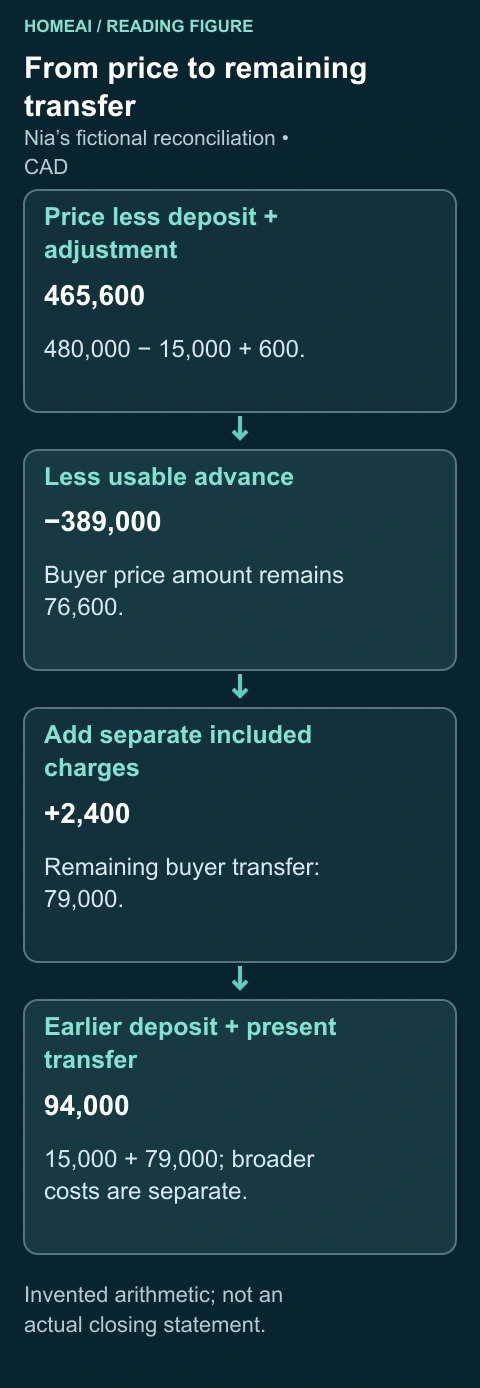
Fictional buyer Nia agrees an invented CAD 480,000 purchase. The contract credits a CAD 15,000 deposit already received. For this teaching case only, the professional’s verified adjustments add CAD 600, making CAD 465,600 the remaining price-side amount to settle. No actual property, tax allocation, standard deposit or current fee is represented.
The invented lender documents identify a CAD 390,000 gross advance and CAD 1,000 of expressly identified deductions in this case, leaving CAD 389,000 usable toward completion. The nature and permissibility of those invented deductions would require actual documents in a real transaction. This is an arithmetic assumption, not a claim that Canadian lenders commonly deduct that amount.
Subtracting CAD 389,000 from CAD 465,600 leaves CAD 76,600 for the buyer to supply toward the adjusted price. Suppose the invented legal funds request also includes CAD 2,400 of separately identified closing charges not already paid. The request becomes CAD 79,000. Nia confirms with the professional which items are included before transferring anything.
The deposit has already left Nia’s account. Including it, the buyer cash used in this invented closing reconciliation totals CAD 94,000: CAD 15,000 earlier plus CAD 79,000 now. Separately paid investigations and moving expenses would be added only to the broader acquisition cash plan, once each is identified. They do not belong in the same total twice.
Nia also confirms when the CAD 79,000 must be received, how its source is documented and which verified instructions apply. She retains an ownership reserve outside the transfer. This fictional case demonstrates the full reconciliation and its boundary; it is not a legal statement, recommended reserve, borrower approval, applicable deduction or estimate of anyone’s actual closing costs.
From price to remaining transfer
The invented price-side balance is CAD 465,600. Subtracting CAD 389,000 usable financing and adding CAD 2,400 separately included charges produces CAD 79,000 to transfer. Including the earlier deposit makes CAD 94,000 in this bounded cash reconciliation.
Numbers identify the parts explained below.
- Price less deposit + adjustment
465,600. 480,000 − 15,000 + 600.
- Less usable advance
−389,000. Buyer price amount remains 76,600.
- Add separate included charges
+2,400. Remaining buyer transfer: 79,000.
What does this illustration leave out?
No applicable tax, fee, deduction, loan approval, legal statement or broader acquisition total is established. This illustration explains an idea. It is not an installation guide.
Can every line of the actual final funds request be reconciled to its current supporting record?
Explore this with HomeAI ↗Opens an editable question. Nothing is sent until you choose to send it.Read the complete figure
From price to remaining transfer
Nia’s fictional reconciliation • CAD
- Price less deposit + adjustment
- 465,600. 480,000 − 15,000 + 600.
- Less usable advance
- −389,000. Buyer price amount remains 76,600.
- Add separate included charges
- +2,400. Remaining buyer transfer: 79,000.
- Earlier deposit + present transfer
- 94,000. 15,000 + 79,000; broader costs are separate.
Invented arithmetic; not an actual closing statement.
The invented price-side balance is CAD 465,600. Subtracting CAD 389,000 usable financing and adding CAD 2,400 separately included charges produces CAD 79,000 to transfer. Including the earlier deposit makes CAD 94,000 in this bounded cash reconciliation.
What remains unknown: No applicable tax, fee, deduction, loan approval, legal statement or broader acquisition total is established.
A useful question: Can every line of the actual final funds request be reconciled to its current supporting record?
Which professional answers each unresolved question?
The lender or mortgage professional explains the borrowing offer, outstanding conditions, advance and lender charges. Ask them to identify who is represented and the limits of their role. A lender’s property valuation or financing approval does not establish that the physical house has no defects or that every intended use is authorized.
The lawyer or appropriate notary explains the agreement, title and registration, legal closing reconciliation and the actual funds instructions within the retainer. Ask about the scope of advice and which outside specialist is needed for a tax, survey or technical question. Do not infer that paying legal fees includes an engineering assessment or a complete evaluation of equipment.
Your real estate representative connects agreed price, dates, terms and amendments and assists with authorized transaction communication. Technical specialists describe their actual inspection, test or proposal. Those findings can inform a negotiated decision, but they do not themselves amend the purchase price or create a unilateral right to withhold funds.
For a material cost, ask for a scoped written proposal rather than treating an illustrative allowance as a quote. For a programme or tax assumption, obtain current official information and individual advice. For a disputed contractual amount, obtain legal advice. Each response should identify the property, date, scope and assumptions so a future reader understands what it actually resolves.
Keep the buyer’s decision record short and useful: the open question, responsible person, response date and the document that closes it. A request sent is not an answer received. If time runs short, flag the unresolved issue promptly rather than marking the entire closing plan complete because most of its lines have been filled.
What belongs in the final closing and possession record?
Retain the accepted agreement and amendments, deposit confirmation, final legal reconciliation and account, lender records and the applicable registration or title documents. Ask the legal professional which final documents will arrive later and how outstanding items are tracked. A request or submission is not the same as a completed registration or confirmed outcome.
Keep actual paid amounts separate from estimates and future obligations. Confirm any refund, credit, adjustment or follow-up under the professional’s process. Carry unresolved physical work into the home-care record with the provider and scope attached. Do not describe a promised repair as completed merely because the transaction itself has closed.
Before possession, coordinate the actual insurance, utility and access arrangements with the advisers and providers. Different contracts and jurisdictions can allocate risk and possession differently, so this guide does not prescribe one universal start time. Ask how the real agreement treats the interval and what confirmation is needed.
If the property or inclusions differ from the agreed arrangement, document the observation and promptly consult the representative and legal professional. Do not improvise a financial deduction or assume the funds transfer can simply be reversed. The closing-cash guide explains the money path; the actual legal options depend on the agreement and facts.
A complete cash plan leaves you able to explain the price, earlier credit, actual advance, adjustments, closing charges and remaining buyer transfer, with every important date attached. Continue from there into the first-year ownership budget. Having enough to acquire the home is one decision; caring for its systems and funding future needs is the next.
Keep learning about the connected parts
- Understanding mortgage structure: payments, balance and flexibility
- Your first year in a home: turn findings and bills into a budget
- Before you make an offer: what to check, who to ask
- Renovation records: what was proposed, approved and built?
- Build a home-care record that the next person can understand
- Know what your private well is supplying
- Buying with septic: assess the whole treatment system
- Renew, switch, refinance or break: compare the actual mortgage change
- Title, survey and physical property: reconcile the actual site
- Inherited equipment agreements: identify what transfers
- Selling one home and buying the next: money, dates and dependencies
- Private roads and shared services: connect access, upkeep and the actual agreement
Canadian context and authorities · Visual atlas · Learning labs
Practice the distinction.
From an adjusted price to the remaining transfer
Fictional Nia reconciles an invented CAD 480,000 purchase with a CAD 15,000 earlier deposit, CAD 600 adjustment, CAD 389,000 usable advance and CAD 2,400 separately included charges.
Reported observations
- Remaining adjusted price: CAD 465,600.
- Buyer price contribution still required: CAD 76,600.
- Final illustrative transfer: CAD 79,000; earlier deposit remains separately credited.
Compare the explanations
Expand each possibility to see the evidence needed to distinguish it. Similar symptoms can have different mechanisms.
Two documents describe different money boundaries
A price-side balance can differ from the buyer’s final transfer because it does not include the same funding and charges.
The itemized reconciliation and actual advance documents.
An estimate uses an outdated assumption
A changed amount or date can alter the current funds request.
Accepted amendments, dated bill/credit evidence and the current professional instructions.
A useful next question
Have the actual professional confirm the final amount, source, deadline and authenticated recipient before transferring funds.
Invented arithmetic only; no legal statement, lender deduction rule, applicable tax, current fee, reserve recommendation or borrower approval.
Know what the words mean.
- Closing-funds reconciliation
- The explanation connecting price, credits, actual available financing, adjustments and separately included charges to the remaining buyer funds.
- Deposit credit
- Money already paid under the agreement accounted for toward the transaction, rather than charged a second time.
- Mortgage advance
- Money actually released under the lender’s conditions, distinct from an early estimate or commitment.
- Usable advance
- The amount identified as available for completion after any actual documented treatment of charges or deductions.
- Closing adjustment
- An identified allocation or credit between parties under the actual transaction and supporting records.
- Disbursement
- An identified expense incurred in carrying out a professional service, distinct from the professional fee itself.
- Funds deadline
- The actual confirmed time by which the required recipient must have funds in the accepted form.
- Acquisition cash plan
- The dated plan including the deposit, investigations, completion funds and other identified purchase expenses.
Questions to bring
to the conversation.
- Which price and amendments does the current statement use?
- Where is the deposit credited and receipt confirmed?
- What actual usable advance and remaining conditions are documented?
- Which adjustments and charges are supported and not counted twice?
- When must funds be received, and how are instructions authenticated?
Separate a showing observation, an existing record and a new professional assessment. Unknown means a question remains; it does not automatically mean a defect.
Use the evidence planner ↗Go to the source.
Original HomeAI explanation informed by these public references. Sources support the underlying guidance; they have not reviewed or endorsed HomeAI. Diagrams are conceptual, and calculator outputs depend on your inputs.
Current full FCAC and CMHC substantive bodies and the complete 34-page current-host RECA PDF were read October 13, 2026. FCAC page details are October 20, 2025 (Buying a home), December 1, 2025 (Real estate fraud) and October 15, 2025 (mortgage rights). CMHC and RECA substantive revision dates were not established; current hosting and a copyright footer do not establish revision. Their old numerical prices, eligibility statements and categorical insurance/legal timing were withheld. Two obsolete RECA PDF URLs returned 404, the first CMHC worksheet route was inaccessible and the BC transfer-tax URL returned 502; these holds supply no tax or fee claim. The Alberta payment warning is a complete one-page mechanism example without an established printed date. All monetary examples are expressly invented Canadian-dollar arithmetic; actual contracts, professional scope, lender instructions, tax treatment and local process govern.
Publication & source review
First published .
Sources reviewed .
- FCAC — Buying a home
Where this reference applies
Jurisdiction: Canada; general consumer cost categories
Edition: Page details October 20, 2025.
Source reviewed: 2026-10-13 · America/Edmonton
Reading scope: Complete current substantive body read, lines 22–120; parsed web capture retained.
Upfront acquisition expenses are additional to borrowing; legal work, property-tax adjustments, inspection and insurance are examples. Programme limits and broad percentage budgets not adopted.
- CMHC — How much will my home really cost?
Where this reference applies
Jurisdiction: Canada; illustrative categories, with explicit currency disclaimer
Edition: No substantive revision date established; ©2026 footer is not a revision date.
Source reviewed: 2026-10-13 · America/Edmonton
Reading scope: Complete substantive body read, lines 134–199; original current parsed web body retained.
Deposit/down-payment relationship, legal and registration expenses, prepaid costs, insurance, survey and property-specific investigation categories. Old illustrative prices and simplified eligibility statements withheld.
- RECA — Home Buyer’s Guide, current consumer CDN copy
Where this reference applies
Jurisdiction: Alberta; contract and legal process examples remain local
Edition: No printed substantive revision established; present CDN retrieval is not proof of a new edition.
Source reviewed: 2026-10-13 · America/Edmonton
Reading scope: Complete 34-page PDF extracted and read; original and 74,947-character full text retained. SHA256 11b37d04a59788f18fcdbae29fa0e1b1baf12a77d803842c11e4475bb0dab1ee. Two obsolete RECA URLs returned 404 and remain held.
Deposit terms/credit, financing conditions and instructions, legal preparation, title/survey questions, costs and property-tax adjustment. Old eligibility figures, universal insurance timing and categorical legal results not adopted.
- FCAC — Getting a mortgage: know your rights
Where this reference applies
Jurisdiction: Federally regulated financial institutions, including banks and federal credit unions; not all Canadian lenders
Edition: Page details October 15, 2025.
Source reviewed: 2026-10-13 · America/Edmonton
Reading scope: Complete 151-line current page read; retained parsed web reading. Federal disclosure scope remains explicit.
Information-box fields, rate and compounding disclosure, payment elements, privileges, charges, variable-rate method and fixed-payment trigger-rate disclosure.
- FCAC — Real estate fraud
Where this reference applies
Jurisdiction: Canada; consumer identity and transaction precautions
Edition: Page details December 1, 2025.
Source reviewed: 2026-10-13 · America/Edmonton
Reading scope: Complete 122-line current page read, including all substantive lines 23–84; parsed capture retained.
Read documents, use appropriate professionals, protect financial information, avoid false borrowing information and obtain legal advice before granting rights.
- Law Society of Alberta — Fraudulent Payment Instructions
Where this reference applies
Jurisdiction: Alberta legal-profession warning; scam mechanism, not a complete national consumer transfer protocol
Edition: No printed substantive date established; URL directory year is not treated as publication date.
Source reviewed: 2026-10-13 · America/Edmonton
Reading scope: Complete one-page PDF, all 21 extracted lines, read through web tool. No claim that an actual scam occurred or that a client is fully protected.
Displayed sender names can disguise a different sender address; payment-control processes matter. Guide’s known-channel confirmation is a practical enquiry, not a guarantee.
Have a question about your home?
Start with the symptom, timing and what you have observed.
Ask HomeAI