Jump to a question in this guide
- What does shared heat mean for a household?
- How do source, network and building equipment connect?
- How is heat movement different from domestic water supply?
- What does the local heat pump do?
- Who owns and maintains each part?
- How do accounts and bills relate to the machinery?
- What should transfer at a purchase or tenancy change?
- How should a comfort or service concern be reported?
- What does redundancy tell you, and what does it leave open?
- How do renovations and equipment replacement affect the boundary?
- Why can two district-energy buildings have different local equipment?
- How do room controls differ from building and utility controls?
- What does a summer bill tell you about cooling and energy use?
- How do building, network and household stages stay coordinated?
- What does a fictional two-contact enquiry show?
- Which handover note helps the next resident?
- Follow thermal energy from the shared source and network into the equipment that actually heats, cools or supplies hot water to this home.
- Utility ownership, in-home equipment care, billing and account authority can have different boundaries; obtain the property-specific explanation.
- An account transfer or network backup statement does not verify local equipment, every supplied function or the household’s interruption plan.
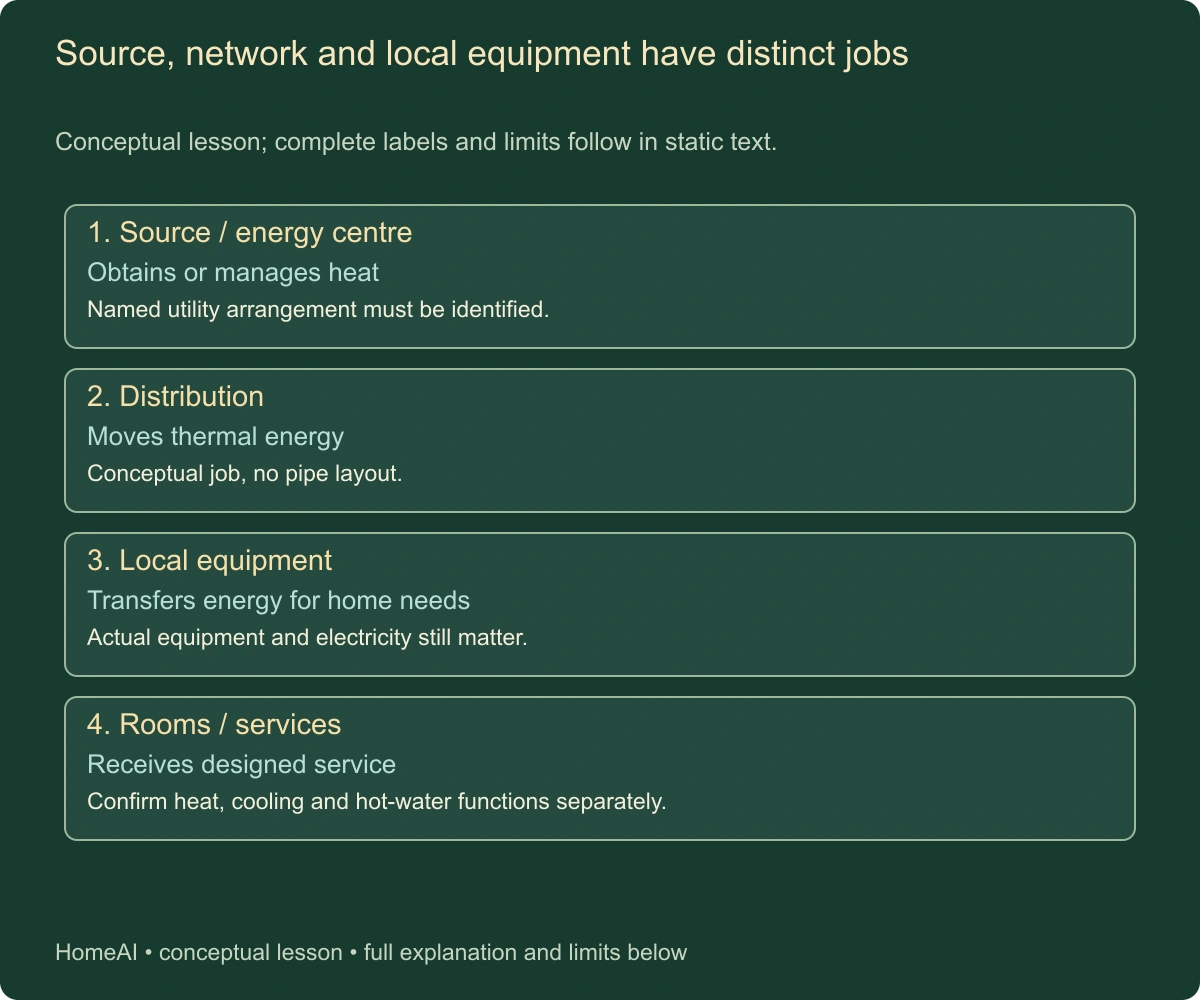
The job chain traces thermal energy through the described arrangement. It is not a water-plumbing network or a drawing of every district.
About this illustration
No installed topology, fluid, temperatures, capacities, settings or drinking-water connection. This is a conceptual teaching model, not an assessment of your home.
9 picture lessons appear beside the questions in this guide. Use them to understand the explanation, then consider what it means for your home.
What does shared heat mean for a household?
A home's thermostat is the familiar place where a resident asks for comfort. The equipment that responds may serve only that home, an entire building or a larger community network. Shared heating means that some production or distribution resources are used by more than one household. It does not identify the exact machinery, account arrangement or owner responsibility at a property.
Start by asking what supplies space heat, cooling and domestic hot water separately. A building may share one service and have individual equipment for another. The presence of a radiator, fan coil or heat pump in a suite tells only part of the story. Request a plain-language description connecting the community or building supply with the household's own equipment and service contacts.
This guide uses Blatchford Renewable Energy in Edmonton as a named current Canadian example. Its district-energy and customer-support pages were captured and read on October 14, 2026; no page revision date was established. The example explains source, network, building equipment and customer boundaries. Its promotional savings, efficiency, emissions, lifetime and reliability promises are not adopted as guarantees for a reader's home.
Do not assume a different district works the same way. A utility's technical arrangement, ownership documents, service terms and current professional advice determine the actual answer. This enquiry concerns shared heat and responsibilities. The separate apartment-water guide explains water distribution, and equipment-specific guides remain necessary for the actual appliance and service procedure.
A shared arrangement can be invisible from the dwelling. The local cabinet and wall control may look ordinary while the source and some responsibilities sit elsewhere. That is why the service map should begin with functions, then identify the actual provider and equipment. An absence of a furnace in the home does not settle every heating, cooling or maintenance question.
Which parts of heat delivery may be shared
cutaway with rooms and fully closed basement cabinet; all service connections hidden.
Numbers identify the parts explained below.
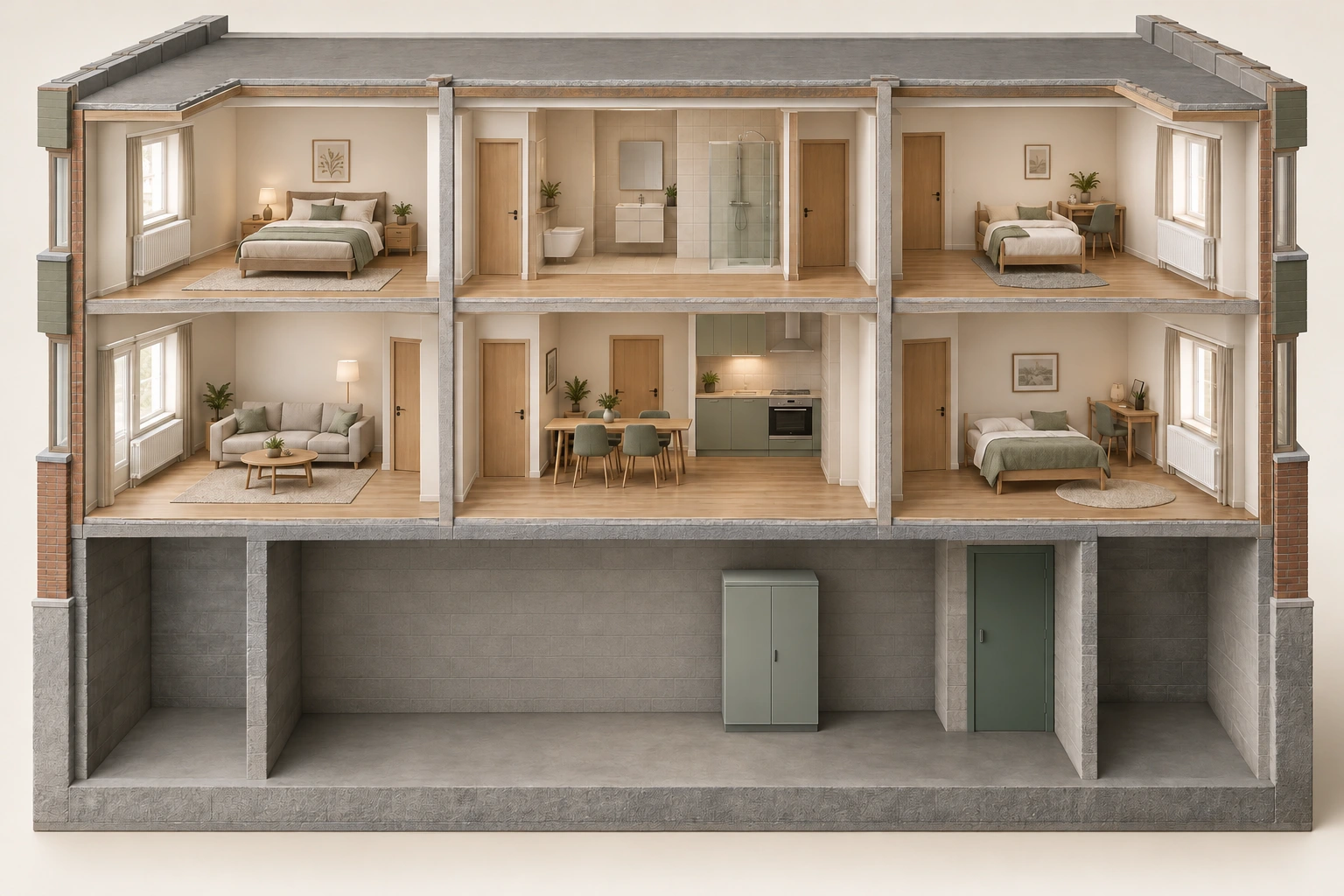
What does this illustration leave out?
Conceptual generated context. No actual property, installed design, topology, measured performance, approval, ownership or responsibility established. This illustration explains an idea. It is not an installation guide.
Which parts of heat delivery may be shared?
Explore this with HomeAI ↗Opens an editable question. Nothing is sent until you choose to send it.Follow shared energy through a named Blatchford example
Choose any stage or play the lesson. A complete pass from stage 1 lasts 64 seconds, with eight seconds per reading stage during playback. Paused and manually selected stages remain available as long as you need. These highlights are not physical cycle times, control settings, measured performance or a test result.
Blatchford, Edmonton is the illustrated example, using the retained undated utility pages observed October 14, 2026. NRCan’s Zibi case, modified May 28, 2025, is a separate contrast. No system-wide savings, performance or asset-ownership guarantee is adopted.
- Geoexchange and energy centre: In the named example, source energy is exchanged and prepared for the community network.
- Distribution loop: Circulates an energy-carrying fluid between the network and buildings; it is not drawn as drinking water.
- Local heat pump: Uses electricity to move thermal energy for the building’s needs.
- Room delivery and controls: Depend on the actual building system.
- Service boundary: Ownership, billing and maintenance must be established by the actual agreements and equipment records.
Paused at stage 1 of 8.
Keyboard: use Tab to reach a control and Enter or Space to activate it. On a stage button, Left/Right selects the previous/next stage; Home/End selects the first/last stage.
Identify the named system before following its pipes
Shared heating describes a service arrangement, not one universal machine. This drawing follows Blatchford’s geoexchange, energy centre, distribution network and local heat pump. It does not establish the equipment in another neighbourhood.
Useful question: Which utility, building and equipment records identify this service?
All eight reading stages
Identify the named system before following its pipes
Shared heating describes a service arrangement, not one universal machine. This drawing follows Blatchford’s geoexchange, energy centre, distribution network and local heat pump. It does not establish the equipment in another neighbourhood.
Useful question: Which utility, building and equipment records identify this service?
The source exchanges energy with the ground
Blatchford describes a geoexchange field that exchanges thermal energy with the ground. Its piping leads toward the energy centre. The concept is energy movement, not groundwater or drinking water delivered to the suite.
Useful question: What source and actual network arrangement are documented here?
The energy centre serves the community loop
In the named example, the energy centre uses a heat pump to prepare energy for the distribution system. Electricity supports heat-pump operation. This lesson adopts no numerical efficiency, year-round capacity or uninterrupted-service promise.
Useful question: Which current utility description and service limits apply?
Distribution pipes carry energy between buildings and the network
The community piping circulates an energy-carrying fluid. That fluid route has a different job from a household drinking-water route. The drawing shows supply and return conceptually, without connection or installation details.
Useful question: Where do the actual distribution and building boundaries lie?
The local heat pump serves the building
A local heat pump moves energy between the network and the building system using electricity. The actual equipment supplies the relevant heating, cooling or hot-water arrangement. A room control is not direct control of the community energy centre.
Useful question: Which local heat-pump model and indoor delivery system serve this space?
Heating and cooling move energy in different directions
Blatchford describes energy sharing and a reversible local heat-pump role: heating brings useful energy to the building, while cooling removes excess building heat toward the network. The highlighted reading route is a heating example, not an instruction to change modes.
Useful question: What does the actual system record establish about heating and cooling?
Another district system can use a different arrangement
NRCan’s Zibi case describes industrial waste heat, central heat pumps and different building arrangements on the Quebec and Ontario sides. It is a contrast, not evidence that every shared system has a Blatchford-style local heat pump or identical service boundary.
Useful question: Which features are established for this property rather than borrowed from another example?
Separate operation, billing and asset responsibility
Blatchford distinguishes utility operation from EPCOR billing and directs equipment questions to the actual model and qualified service. Condo communication and equipment responsibilities also depend on the arrangement. Keep the service agreement, asset schedule and contact route together; a warm room does not establish who pays for a repair.
Useful question: Who is responsible for each asset, account and reported problem under the actual documents?
Use the source notes in this guide to check the named examples, adopted scope and limits.
Which parts of heat delivery may be shared
cutaway with rooms and fully closed basement cabinet; all service connections hidden.
What remains unknown: Conceptual generated context. No actual property, installed design, topology, measured performance, approval, ownership or responsibility established.
A useful question: Which parts of heat delivery may be shared?
How do source, network and building equipment connect?
A thermal source provides or receives heat. Energy-centre equipment manages energy for a distribution network. Pipes carry a circulating fluid between connected locations. At a home or building, equipment transfers heat into or out of the spaces and services it is designed to serve. These are distinct jobs even when a utility describes the whole arrangement with one brand name.
Blatchford's current explanation describes a geoexchange field, an energy centre with heat-pump equipment, underground distribution piping and heat pumps at connected homes and buildings. It also describes energy sharing between buildings and seasons. This is the named system's explanation, not a drawing of every district-energy installation or a claim that every future stage has already been constructed.
The important relationship is heat transfer across the actual boundaries. A network can supply thermal energy while local equipment still needs electricity, controls and professional service. The fact that heat originated outside the home does not establish that the resident has no equipment-related obligation. Obtain the actual diagram and service description rather than infer responsibilities from the word district.
A conceptual illustration in this guide names those jobs without specifying pipe layout, fluid temperatures, capacity, controls or safety settings. The installed network and equipment need their own records. A resident should not use a generic diagram to identify valves, trace hidden pipes or make changes inside a mechanical enclosure.
Energy transfer and ownership are independent descriptions. A utility might explain where heat moves while a service agreement explains which asset it owns. Do not use a flow diagram as a substitute for that agreement. Similarly, an ownership boundary does not disclose the control sequence or equipment condition. The household needs each explanation under its own documented scope.
Source, network and local equipment have distinct jobs
The job chain traces thermal energy through the described arrangement. It is not a water-plumbing network or a drawing of every district.
Numbers identify the parts explained below.
What does this illustration leave out?
No installed topology, fluid, temperatures, capacities, settings or drinking-water connection. This illustration explains an idea. It is not an installation guide.
Which actual records and qualified advice answer this distinction?
Explore this with HomeAI ↗Opens an editable question. Nothing is sent until you choose to send it.What does a building energy-transfer interface look like
Generic plate-style closed equipment and cabinet context; three visible pipe connections do not establish topology, separation or any Blatchford installation.
Numbers identify the parts explained below.
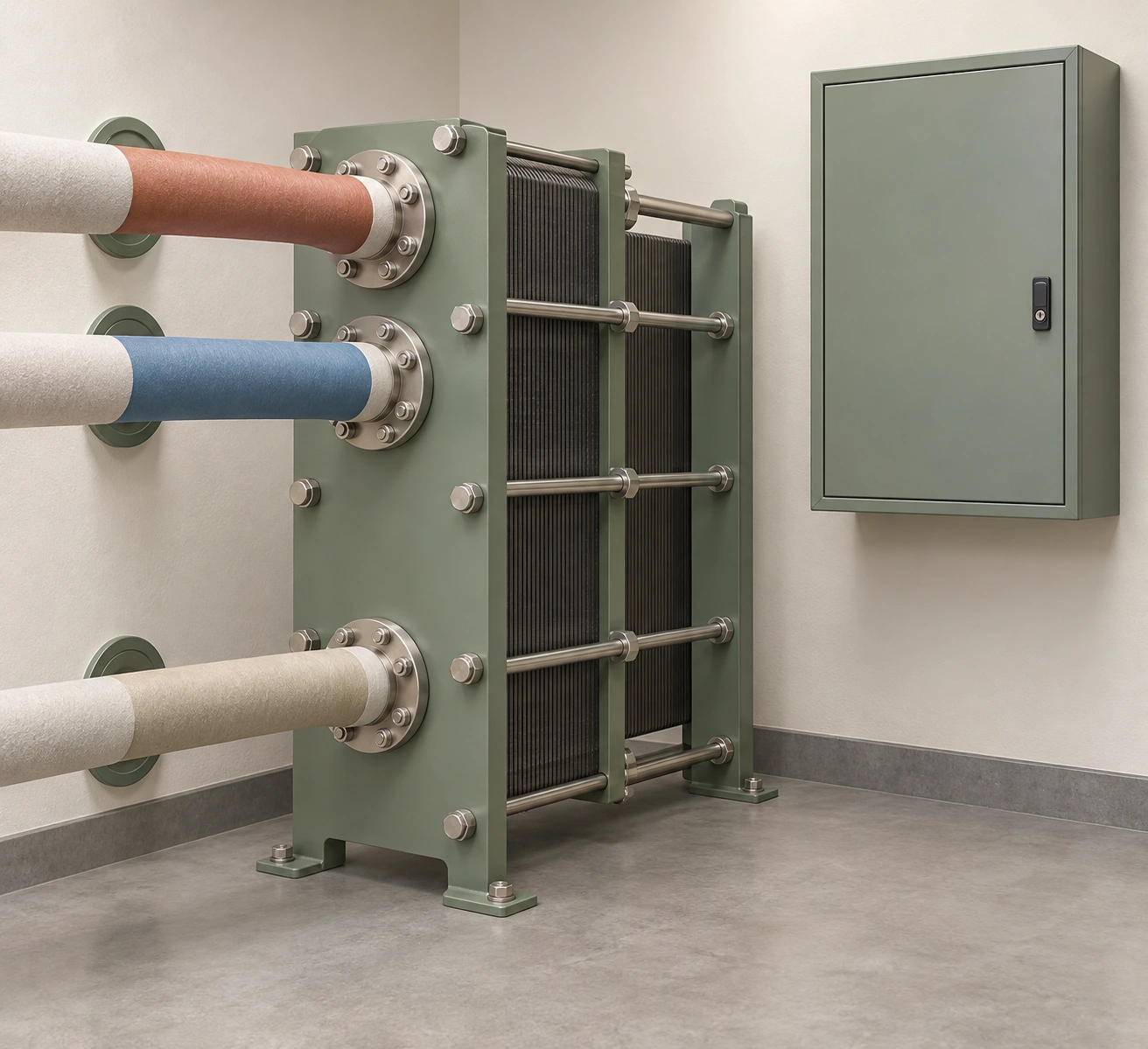
What does this illustration leave out?
Conceptual generated context. No actual property, installed design, topology, measured performance, approval, ownership or responsibility established. Generic equipment image does not depict an actual Blatchford or Zibi installation. This illustration explains an idea. It is not an installation guide.
What does a building energy-transfer interface look like?
Explore this with HomeAI ↗Opens an editable question. Nothing is sent until you choose to send it.Source, network and local equipment have distinct jobs
Conceptual lesson; complete labels and limits follow in static text.
- Source / energy centre
- Obtains or manages heat. Named utility arrangement must be identified.
- Distribution
- Moves thermal energy. Conceptual job, no pipe layout.
- Local equipment
- Transfers energy for home needs. Actual equipment and electricity still matter.
- Rooms / services
- Receives designed service. Confirm heat, cooling and hot-water functions separately.
The job chain traces thermal energy through the described arrangement. It is not a water-plumbing network or a drawing of every district.
What remains unknown: No installed topology, fluid, temperatures, capacities, settings or drinking-water connection.
A useful question: Which actual records and qualified advice answer this distinction?
What does a building energy-transfer interface look like
Generic plate-style closed equipment and cabinet context; three visible pipe connections do not establish topology, separation or any Blatchford installation.
What remains unknown: Conceptual generated context. No actual property, installed design, topology, measured performance, approval, ownership or responsibility established. Generic equipment image does not depict an actual Blatchford or Zibi installation.
A useful question: What does a building energy-transfer interface look like?
How is heat movement different from domestic water supply?
Water or another fluid can circulate in equipment to carry thermal energy. Domestic water is the water supplied for household use. Those descriptions refer to different functions. A shared heating loop must not be assumed to be the same route as the water coming from a kitchen tap. Ask the utility or building professional to explain the actual interfaces in ordinary language.
The current Blatchford page describes energy travelling in water through its distribution piping and local heat pumps using the thermal energy for building needs. That supports a heat-transfer lesson. It does not establish that network water becomes household drinking water, that every dwelling has identical water-heating equipment, or that the example's generic illustration proves an installed separation detail.
Ask what produces domestic hot water in the actual home, what equipment belongs to the household and which parts depend on the shared service. The records should identify those functions separately from space heating and cooling. A household may need different contacts for a billing question, a hot-water problem and a fault in local equipment.
Keep service connections concealed. Do not sample network fluid, operate isolation devices, remove covers or attempt to determine pipe function by temperature or colour. Qualified professionals and the utility can identify the actual arrangement. The learning goal is to ask a better boundary question, not perform an informal commissioning test.
A domestic-water concern should be reported using the actual symptom and service arrangement rather than the assumption that all water in the building shares a circuit. A shared energy source can participate in heating water while the domestic distribution remains a separate enquiry. The appropriate provider and qualified professional must identify the interfaces and investigation required for the actual building.
What does the local heat pump do?
A heat pump transfers heat using its designed process rather than simply equating electricity input with heat delivered. In the Blatchford explanation, local heat pumps use the network's thermal energy for building heating and hot water, and can remove excess building heat for cooling. The actual unit's capabilities and connected services still depend on its design and installation.
A thermostat request is only one input to the system. Local equipment, controls, electrical supply and the shared service participate in the result. A cold room therefore does not, by itself, locate a problem at the district energy centre. Likewise, an operating display does not establish that every connected service is performing correctly. A qualified assessment must determine the actual fault and scope.
Ask for the make, model, equipment manual and supplied installation/service records through safe visible information or authorized documentation. Do not open a cabinet to obtain an identification number. Blatchford's customer page directs customers toward equipment-specific manuals and technicians familiar with the particular heat pump. This guide adopts that equipment-specific distinction without supplying settings or a universal service interval.
Cooling also needs an actual answer. The named example describes reversible heat-pump cooling, but a household should confirm the capability, distribution and controls of its own installation. The presence of a shared energy connection is not proof that every room or later addition has an agreed cooling service or that the utility maintains all local equipment.
A local heat-pump service record also needs its own equipment match. If a unit was replaced, an old manual or invoice may describe a different model. Ask for the identified current equipment and relevant amendments. An unchanged utility connection does not establish that the old local instructions still apply. Keep concealed components closed while the authorized technician reconciles the records.
What equipment can remain inside a home connected to a shared thermal network
Fully closed cabinet in utility closet beside room; no performance or equipment identification proof.
Numbers identify the parts explained below.

What does this illustration leave out?
Conceptual generated context. No actual property, installed design, topology, measured performance, approval, ownership or responsibility established. This illustration explains an idea. It is not an installation guide.
What equipment can remain inside a home connected to a shared thermal network?
Explore this with HomeAI ↗Opens an editable question. Nothing is sent until you choose to send it.What equipment can remain inside a home connected to a shared thermal network
Fully closed cabinet in utility closet beside room; no performance or equipment identification proof.
What remains unknown: Conceptual generated context. No actual property, installed design, topology, measured performance, approval, ownership or responsibility established.
A useful question: What equipment can remain inside a home connected to a shared thermal network?
Who owns and maintains each part?
Ownership, operating responsibility and maintenance responsibility can have different boundaries. Ask for a component-by-component explanation identifying the utility's assets, building-owned equipment and any equipment assigned to an individual household. A marketing statement about a shared system should not substitute for the actual service agreement and governing property documents.
The Blatchford pages illustrate why boundaries need care. The district-energy page describes utility ownership and maintenance of district equipment in condominium buildings, while the customer page says the utility is not responsible for operation or maintenance of the heat pump inside a home. Those statements should be read together as a reason to obtain the property's specific boundary, not collapsed into a promise of free lifetime maintenance for all heating equipment.
Ask where responsibility changes physically and contractually. The service description may identify a connection point, meter, heat exchanger or other boundary suited to the actual system. The legal professional and utility must explain its effect. A resident cannot establish ownership from a pipe entering the building or a utility logo beside a cabinet.
Also ask who can authorize work affecting shared equipment. An individual suite contractor may need coordination with management or the utility before carrying out a proposed alteration. Keep authorized professional access and household account authority distinct. A resident's right to live in the home does not itself explain who may change the shared network.
Compare the boundary descriptions when two documents appear to conflict. They may concern utility district assets and in-home equipment respectively, rather than make opposite statements about the same component. Ask the actual provider and legal professional to resolve the scope in writing. This guide leaves the property-specific answer open rather than choosing the most favourable sentence from a marketing page.
Ownership and service need actual boundaries
Separate boundaries prevent a district-service promise from becoming a claim that every local appliance is utility-maintained.
Numbers identify the parts explained below.
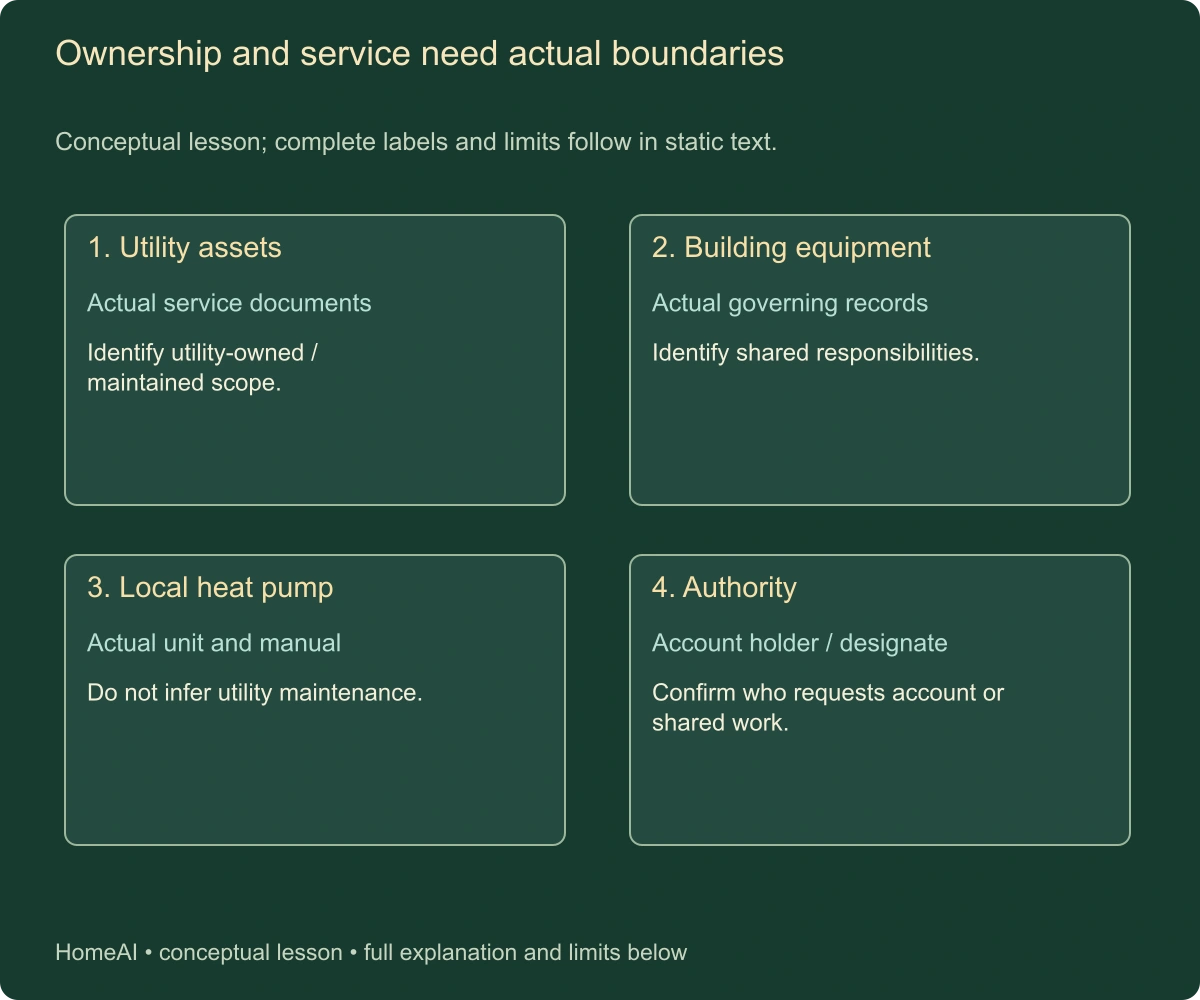
What does this illustration leave out?
No actual ownership, free maintenance or liability decision. This illustration explains an idea. It is not an installation guide.
Which actual records and qualified advice answer this distinction?
Explore this with HomeAI ↗Opens an editable question. Nothing is sent until you choose to send it.Ownership and service need actual boundaries
Conceptual lesson; complete labels and limits follow in static text.
- Utility assets
- Actual service documents. Identify utility-owned / maintained scope.
- Building equipment
- Actual governing records. Identify shared responsibilities.
- Local heat pump
- Actual unit and manual. Do not infer utility maintenance.
- Authority
- Account holder / designate. Confirm who requests account or shared work.
Separate boundaries prevent a district-service promise from becoming a claim that every local appliance is utility-maintained.
What remains unknown: No actual ownership, free maintenance or liability decision.
A useful question: Which actual records and qualified advice answer this distinction?
How do accounts and bills relate to the machinery?
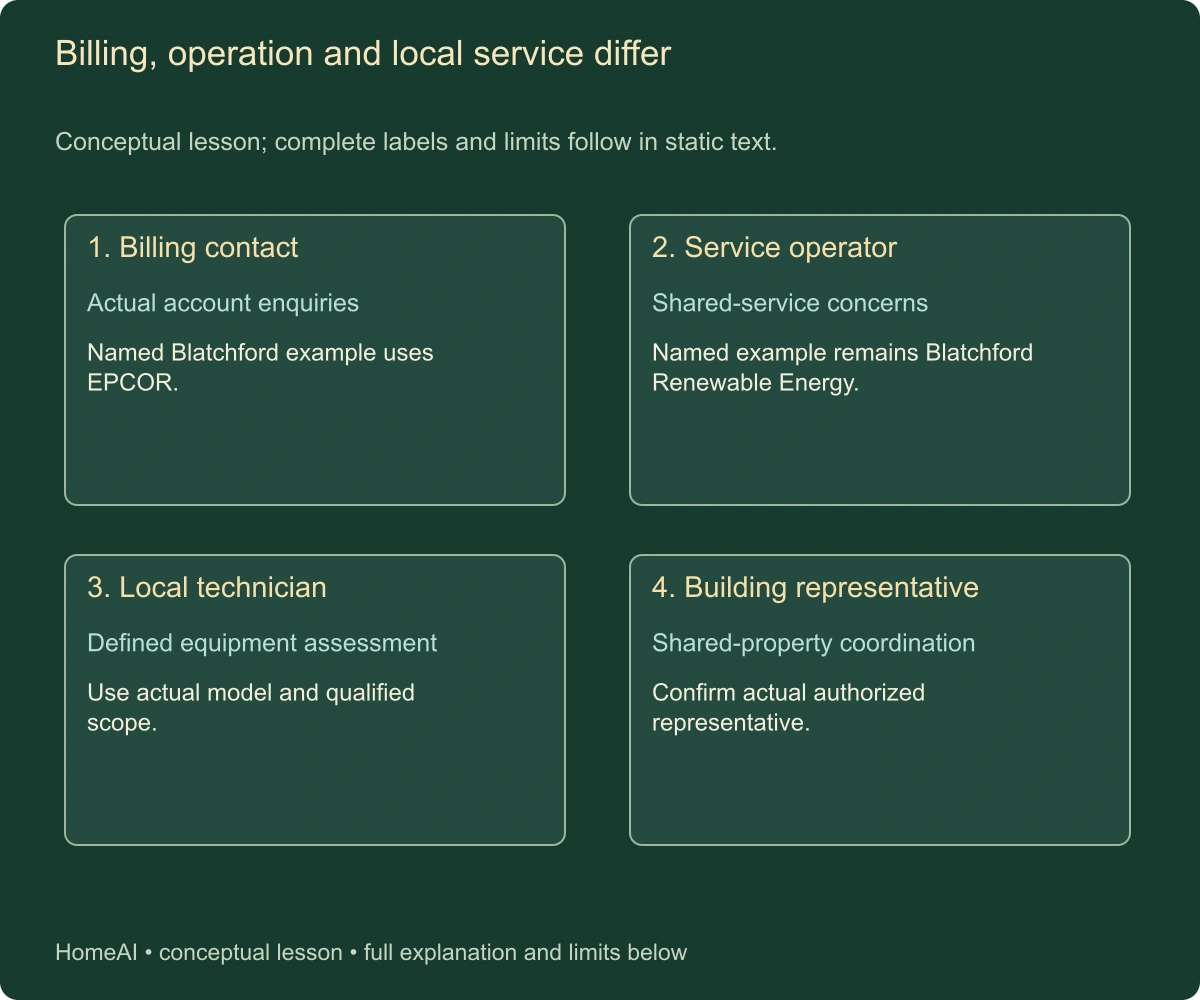
The billing organization can differ from the service operator. Blatchford's customer-support page identifies EPCOR for starting, stopping or transferring service and billing enquiries, while operation and management of the energy service remain with Blatchford Renewable Energy. This is a named example of two roles, not a rule for all districts.
Ask who holds the account for the actual property: the individual household, building corporation, landlord or another authorized party. Then ask how charges reach the resident. A shared system can have a building bill and a separate allocation process. Do not infer an individual utility account simply because energy reaches an individual suite.
Read a sample actual bill with the account holder's authorization and private information appropriately restricted. Identify the charge categories, billing period and any quantities shown, using the provider's explanation. A fixed charge and a use-related charge have different jobs. This guide supplies no current tariff, future rate, savings estimate or universal allocation formula.
The named provider says rates can change and distinguishes current charges from policy about comparison with other services. A household should obtain current applicable terms instead of treating a promotional cost comparison as a binding multiyear budget. Retain unresolved rate or allocation questions separately from a technical equipment enquiry.
An actual bill can include amounts whose purpose is not obvious from a short label. Ask the billing organization to explain the charge and its period using the current account terms. Keep a provider’s future-rate policy separate from a fixed quotation. The named example’s promotional comparison supplies no guarantee that every household will pay the same amount as an alternative heating system.
Billing, operation and local service differ
Four roles can coordinate but a bill enquiry does not establish a technical assessment.
Numbers identify the parts explained below.
What does this illustration leave out?
No current emergency hours, tariff, approval or contact response guarantee. This illustration explains an idea. It is not an installation guide.
Which actual records and qualified advice answer this distinction?
Explore this with HomeAI ↗Opens an editable question. Nothing is sent until you choose to send it.Billing, operation and local service differ
Conceptual lesson; complete labels and limits follow in static text.
- Billing contact
- Actual account enquiries. Named Blatchford example uses EPCOR.
- Service operator
- Shared-service concerns. Named example remains Blatchford Renewable Energy.
- Local technician
- Defined equipment assessment. Use actual model and qualified scope.
- Building representative
- Shared-property coordination. Confirm actual authorized representative.
Four roles can coordinate but a bill enquiry does not establish a technical assessment.
What remains unknown: No current emergency hours, tariff, approval or contact response guarantee.
A useful question: Which actual records and qualified advice answer this distinction?
What should transfer at a purchase or tenancy change?
Identify the responsible account and exact change process before assuming that possession of the home establishes service transfer. Ask the provider or management who must give notice, what effective date applies, which authority is needed and what confirms the change. Keep the planned completion date distinct from confirmation that the actual account was updated.
Blatchford's customer page says account-specific information goes only to the confirmed account holder or designate, and directs billing and service transfers to EPCOR. It also describes designated representation for residences with condominium boards. These are useful role distinctions. A buyer or agent should not assume authority to access another person's account merely because a transaction is underway.
Retain the relevant manuals, service contact information, current agreements and identified equipment records with the handover file. If the building is the customer, ask management how a new owner receives operating information and reports a concern. If the household has an individual account, obtain its own confirmation through the provider's known process.
Check the first applicable statement against the agreed date and account arrangement. A missing charge does not establish that the service is free or that an obligation ended. An unexpected charge needs an account enquiry, while a comfort concern needs an appropriate service enquiry. The two may occur together without having the same cause.
If completion is delayed, ask which parties update the relevant effective dates. The seller’s account, buyer’s account, building representative and local service provider may need different information. A request made before possession is useful evidence of a request, while provider confirmation establishes its actual account outcome. Do not assume that physical handover automatically completes every administrative change.
How should a comfort or service concern be reported?
Begin with the actual symptom and safe observations: which room or service is affected, when it began, whether other residents reported a similar issue and what the display or notice says if safely visible. Keep a household observation separate from a technical diagnosis. Do not infer network failure from one cold room or local equipment failure from a district notice alone.
Ask for the building's current reporting process and emergency contacts. A shared service may use a designated building representative, while local equipment has a different technician. Blatchford's current customer page explicitly distinguishes those roles. It contains time-dependent contact details, so the actual utility page and building instructions should be checked when needed instead of relying on an old handover sheet.
For an emergency or immediate hazard, follow the responsible emergency service and building instructions. Do not operate shared valves, reset unfamiliar equipment or open cabinets while trying to determine the boundary. The system's shared nature makes coordination important: changing one component can affect people beyond the household.
For a non-emergency concern, ask what the provider or technician actually assessed and whether a referral remains. A billing agent receiving a report is not proof that a technical investigation occurred. Retain the work order, findings, equipment identity and outstanding recommendations. A closed service ticket can describe an administrative status without establishing every comfort issue was resolved.
Patterns across homes can help the responsible team define an investigation, but they do not determine the cause. Reports from several residents may concern the same service or unrelated local conditions. Keep the original locations, times and descriptions rather than rewriting them as a network failure. The utility, management and technicians can then coordinate the scope supported by the actual evidence.
What does redundancy tell you, and what does it leave open?
A provider may describe backup equipment or redundancy intended to support service. Blatchford's system page makes such statements. They are part of the provider's description, not a guarantee that a particular household will never experience interruption or that every local component has an independent backup.
Ask what the actual service terms and building plan say about interruptions, communication and household dependencies. A shared network, local electrical supply and in-home distribution can have different interruption mechanisms. A network backup statement does not answer every local equipment or power question. The appropriate professionals must explain the actual arrangement.
Households with particular temperature, accessibility or medical needs should obtain a practical plan through the relevant qualified advisers and building contacts. This guide does not prescribe emergency heating equipment or electrical modifications. The useful record identifies who receives notices, which services depend on the arrangement and what authorized assistance is available.
Keep planned outages separate from unplanned faults. A maintenance notice may define a service window, affected area and contact without promising a final completion time under every circumstance. Obtain the current notice and follow-up. An old statement that the utility has backup capacity cannot replace the information about the actual event.
An outage notice should also identify what it actually affects. A shared heating interruption, electrical interruption and local equipment isolation need not describe the same event. Ask management or the provider for the current explanation if the wording is unclear. Avoid treating one broad backup statement as an answer to the household’s particular dependence or emergency plan.
How do renovations and equipment replacement affect the boundary?
A home alteration can change its heating or cooling needs and local distribution. Before replacing equipment or altering connected services, ask the utility, management and qualified designer which approvals and coordination apply. A contractor's offer to replace a unit does not by itself establish compatibility with the shared system or authority to modify its connections.
Obtain the exact proposed equipment and scope. Ask which parts remain, which are changed and how the proposal affects controls, electrical supply, metering and service responsibilities where relevant. These are design and authorization questions. The guide provides no sizing rule, compatibility list, pipe detail or commissioning procedure.
Compare alternatives with the same boundary. A price for local heat-pump replacement cannot be fairly compared with a quotation that includes wider distribution work unless the difference is explicit. A proposal to change the household service arrangement also needs the actual utility and legal answer. Do not assume the resident can disconnect from a district network merely by removing an appliance.
The completed record should identify the equipment, authorized scope, relevant professional checks and remaining responsibilities. A new cabinet proves only that something visible changed. Keep installation and service evidence beside the utility agreement and building records so the next household can understand what changed at each boundary.
A proposed replacement may change local equipment while retaining the shared supply. Ask how the contractor and utility establish the relevant compatibility and completion evidence. The guide does not compare appliance efficiency percentages or recommend a model. The useful comparison identifies included work, approvals, ownership, maintenance and any unresolved service effect on the same basis.
Why can two district-energy buildings have different local equipment?
District energy describes a shared thermal-energy arrangement, not one universal in-home appliance. The provider's source, distribution conditions and building design determine how energy is used locally. A buyer should ask what is installed in this particular building rather than infer a heat pump or fan coil solely from the community name.
Natural Resources Canada's current Zibi project account, modified May 28, 2025, provides a useful named contrast. It describes recovered industrial heat upgraded at a central plant and different local space-conditioning and domestic-hot-water arrangements on the Quebec and Ontario sides of the development. The guide adopts this limited component distinction, not the project's future capacity, carbon, cost or performance promises.
The distinction matters when reading a sales description. A phrase such as district connected may accurately identify the shared service while leaving the local equipment and maintenance boundary unstated. Request the actual equipment schedule or plain-language building explanation. A generic photograph of a heat exchanger in this guide does not establish that the pictured arrangement is installed at Zibi, Blatchford or the home being considered.
Ask how each local function is supplied. Space conditioning, domestic hot water and ventilation are separate enquiries even if some equipment or energy sources overlap. A fan coil, for example, should be identified by its actual equipment and service documents before the household assumes what it does. This guide supplies no internal schematic or interchangeable-appliance claim.
The same caution applies within a large development. Different construction phases, building types or later alterations can have different equipment. The dated project account explains the arrangement it describes; it does not certify every future dwelling or subsequent change. Keep its edition and geography beside the example, then obtain the actual building records.
A practical comparison begins with compatible boundaries: this utility service supplies these functions to this point, and this building or home equipment completes these local jobs. Only then compare ownership, service scope, running costs and proposed replacements. Comparing the name of the source alone would leave most of the household's continuing responsibilities unanswered.
How do room controls differ from building and utility controls?
The resident uses a room control to request an operating condition within the capability provided by the actual system. Equipment and wider controls manage other parts of the service. A wall thermostat is therefore a useful familiar interface, while the response can depend on local and shared components beyond what the resident sees.
Ask which controls the resident is intended to use and which belong to management, the technician or utility. Obtain the actual operating instructions during handover. The guide provides no temperature setting, balancing method, controller sequence or reset procedure. Controls that look similar can serve different equipment, so an instruction from another building may be unsuitable.
A complaint should describe the requested and observed result without becoming a diagnosis. One room behaving differently from another can be useful information, but it does not establish whether the cause is control, distribution, equipment or the building's heat loss. A qualified professional determines the relevant assessment. Do not change unfamiliar shared settings to find out which household is affected.
The service record should say what was assessed: the room control, identified local equipment, building distribution or utility service. If the first provider refers the concern elsewhere, retain that referral and its reason. A technician finding no fault within a narrow appliance scope does not establish that every part of the comfort enquiry has been resolved.
Renovations make these distinctions especially useful. A changed room layout or altered distribution may need professional review of how local controls serve the revised space. The existence of an old thermostat does not prove that a new room has been included in the original design. Obtain the actual scope and completion record before relying on a contractor's broad claim of upgraded heating.
For everyday use, a clear control map is more helpful than a complex generic network picture. Identify the ordinary resident control, the equipment it is documented to serve, the approved instructions and the contact for a problem. Keep wider plant controls outside the household's operating instructions unless the actual authorized documentation expressly assigns a role.
Which visible room parts deliver heat and request it
Room heat emitter and wall control; concealed connections not shown.
Numbers identify the parts explained below.

What does this illustration leave out?
Conceptual generated context. No actual property, installed design, topology, measured performance, approval, ownership or responsibility established. This illustration explains an idea. It is not an installation guide.
Which visible room parts deliver heat and request it?
Explore this with HomeAI ↗Opens an editable question. Nothing is sent until you choose to send it.Which visible room parts deliver heat and request it
Room heat emitter and wall control; concealed connections not shown.
What remains unknown: Conceptual generated context. No actual property, installed design, topology, measured performance, approval, ownership or responsibility established.
A useful question: Which visible room parts deliver heat and request it?
What does a summer bill tell you about cooling and energy use?
A bill records charges under an account arrangement for a stated period. It does not independently show how every room was conditioned or which component used energy. A household needs the provider's explanation of the charge categories and the actual equipment arrangement before comparing seasonal amounts.
Blatchford's current customer-support page explains that its reversible heat-pump service can provide cooling and that summer cooling contributes to energy charges. The relevant lesson is that no space-heating demand does not necessarily mean no thermal-service use. It does not establish a fixed summer amount, an annual savings percentage or the consumption of a particular home.
Compare like periods and known conditions when asking a billing question. Occupancy, weather, actual service use and equipment changes can differ. Keep those facts available to the authorized account enquiry instead of assuming that any increase proves a faulty meter. The provider must explain what the account records and what process is available for investigation.
A generic pipe-mounted instrument in this guide is visual context only. Its appearance does not establish the complete metering system, measured quantity, sensor configuration, reading accuracy or billing method. No household calculation or adjustment should be made from the picture. Request the actual provider's description and documentation for the meter and account in question.
If an account allocates a building charge among residents, ask for the actual allocation process through the responsible party. A shared utility bill and an individual household charge can be related without being the same measurement. The legal and governing-document enquiry remains separate from the provider's equipment and billing enquiry.
Retain the explanation and outcome. A corrected account entry can establish a billing change without demonstrating a technical repair; a meter or equipment assessment can establish its stated result without deciding every allocation issue. The useful record explains which question was answered and which remains open, so future comparisons do not rely on an unexplained adjustment.
What does a visible meter leave unknown about billing and responsibility
Sealed generic pipe-mounted instrument and closed box; image does not establish complete thermal-meter sensors, measured quantity, readings or installed specification.
Numbers identify the parts explained below.

What does this illustration leave out?
Conceptual generated context. No actual property, installed design, topology, measured performance, approval, ownership or responsibility established. The pictured generic instrument does not establish a complete thermal-meter arrangement or measured quantity. This illustration explains an idea. It is not an installation guide.
What does a visible meter leave unknown about billing and responsibility?
Explore this with HomeAI ↗Opens an editable question. Nothing is sent until you choose to send it.What does a visible meter leave unknown about billing and responsibility
Sealed generic pipe-mounted instrument and closed box; image does not establish complete thermal-meter sensors, measured quantity, readings or installed specification.
What remains unknown: Conceptual generated context. No actual property, installed design, topology, measured performance, approval, ownership or responsibility established. The pictured generic instrument does not establish a complete thermal-meter arrangement or measured quantity.
A useful question: What does a visible meter leave unknown about billing and responsibility?
How do building, network and household stages stay coordinated?
A community network can be built in stages while individual buildings are commissioned and occupied on their own schedules. Blatchford describes staged expansion, and the NRCan Zibi account distinguishes early temporary plant work, later permanent plant operation and anticipated buildout. Those examples show why completed, operating and future descriptions should stay attached to their dates.
Ask which stage actually serves the building being purchased. A future community rendering is not an equipment record, and a provider's completed-project account does not settle every household connection. The seller, developer, management and utility can each have a different piece of the information. Obtain the actual service confirmation and identified local equipment through the appropriate authorized parties.
For a new or altered home, ask what documentation addresses the local installation and the provider connection separately. An occupancy milestone, utility account and contractor invoice have different functions. They should not be treated as interchangeable commissioning evidence. The responsible professionals and authorities must explain the actual completion requirements for the location and work.
The household also needs the current support arrangement during the transition. Which organization receives a local equipment concern? Who communicates a shared-service interruption? Who holds the account before and after completion? Keep the answers beside the relevant effective dates so a general handover promise does not leave the resident without a working contact.
A later change in the network need not mean the household's local equipment was renewed. Conversely, a local replacement need not change the utility's assets or account boundary. Ask which parts changed and request the dated amendment or completion record. The service map should preserve that distinction rather than silently copying the newest community description over the old equipment file.
This staged view is also useful when assessing environmental or performance claims. A proposed future source, capacity or emissions result should not be presented as the present operation of the exact property. The guide adopts no future performance forecast. The household's practical decision needs current functions, responsibilities and unresolved work under the actual connected arrangement.
How can a district provider and several buildings share a service context
Buildings and separate small service building beside street; underground connections concealed.
Numbers identify the parts explained below.

What does this illustration leave out?
Conceptual generated context. No actual property, installed design, topology, measured performance, approval, ownership or responsibility established. This illustration explains an idea. It is not an installation guide.
How can a district provider and several buildings share a service context?
Explore this with HomeAI ↗Opens an editable question. Nothing is sent until you choose to send it.How can a district provider and several buildings share a service context
Buildings and separate small service building beside street; underground connections concealed.
What remains unknown: Conceptual generated context. No actual property, installed design, topology, measured performance, approval, ownership or responsibility established.
A useful question: How can a district provider and several buildings share a service context?
What does a fictional two-contact enquiry show?
In this fictional Edmonton purchase, Sam receives a utility bill and sees a closed heat-pump cabinet. The seller says the district provides the heat, so the household has no equipment responsibility. No actual address, provider approval, account or equipment condition is represented. Sam asks for the actual ownership and service boundary before accepting that conclusion.
The fictional handover identifies one organization for the account and another for operation of the shared service. A qualified technician's scope concerns the identified local heat pump. Sam asks management whether the property uses a designated representative and the utility which assets and responsibilities belong to the specific service agreement.
The example does not invent a failure, tariff or savings result. It shows why an account transfer, a local service record and a shared-system description answer different questions. A warm viewing establishes comfort at that moment, while the records describe continuing obligations and support. None establishes a guarantee of future operation.
If the local manual is missing, Sam records an equipment-information hold. If the account holder is unclear, that is an authority and billing hold. If the ownership boundary is unresolved, the legal and provider enquiry remains open. Those distinctions lead to useful requests without treating every missing answer as a reason to speculate about the machinery.
For this invented household, Sam therefore removes the assumption that the district bill includes every in-home maintenance task. The budget keeps a separate, unquoted local-equipment line until the property-specific responsibility and service scope are confirmed. Sam requests that answer before relying on an all-inclusive ownership budget. This is a decision about the missing evidence, not a finding that the equipment failed or that either organization owes a particular service.
Which handover note helps the next resident?
Write a service map in ordinary language: this source and network supply these functions; this local equipment performs these jobs; these parties own, maintain and bill the relevant parts; this contact handles each kind of concern. Attach the actual document or confirmation supporting each statement and record its date.
Keep the equipment manual, service history, current utility terms, account confirmation and building instructions together while preserving private account information appropriately. Identify unresolved questions and who can answer them. A diagram of the network is helpful context but is not evidence of the home's actual equipment or contract.
Revisit the map after an equipment replacement, service-term change or building alteration. The shared system may remain while a local component or responsibility changes. Retain the dated amendment and completion record rather than silently replacing the old explanation. Future residents benefit from knowing both the current arrangement and the work that established it.
The useful outcome is a connected understanding of heat movement and responsibility. The household can distinguish source, distribution, local equipment, account and professional support, then use the actual provider and building records to resolve the parts a general guide cannot establish.
Keep notices and current provider links accessible to the household without copying private account data into a broadly shared file. A practical handover can identify the known contact process and authorized representative while the account holder retains sensitive information. Recheck time-dependent instructions when needed; a dated project guide is not a permanent emergency-contact directory.
Keep learning about the connected parts
- Apartment water systems: risers, central hot water and shared response
- Inherited equipment agreements: identify what transfers
- Suite ventilation concerns: build a useful investigation with your manager
Canadian context and authorities · Visual atlas · Learning labs
Practice the distinction.
What does a fictional two-contact enquiry show?
In this fictional Edmonton purchase, Sam receives a utility bill and sees a closed heat-pump cabinet. The seller says the district provides the heat, so the household has no equipment responsibility. No actual address, provider approval, account or equipment condition is represented. Sam asks for the actual ownership and service boundary before accepting that conclusion.
Reported observations
- The fictional handover identifies one organization for the account and another for operation of the shared service. A qualified technician's scope concerns the identified local heat pump. Sam asks management whether the property uses a designated representative and the utility which assets and responsibilities belong to the specific service agreement.
- The example does not invent a failure, tariff or savings result. It shows why an account transfer, a local service record and a shared-system description answer different questions. A warm viewing establishes comfort at that moment, while the records describe continuing obligations and support. None establishes a guarantee of future operation.
A useful next question
For this invented household, Sam therefore removes the assumption that the district bill includes every in-home maintenance task. The budget keeps a separate, unquoted local-equipment line until the property-specific responsibility and service scope are confirmed. Sam requests that answer before relying on an all-inclusive ownership budget. This is a decision about the missing evidence, not a finding that the equipment failed or that either organization owes a particular service.
Know what the words mean.
- Thermal source
- Where a described system obtains or rejects heat.
- Energy centre
- Equipment managing thermal energy for a shared network.
- Distribution
- The shared route carrying energy between connected locations.
- Heat pump
- Equipment transferring heat under its designed process.
- Local equipment
- The equipment at the actual home or building boundary.
- Service boundary
- Where the applicable responsibility or service scope changes.
- Account holder
- The authorized party identified for the actual billing arrangement.
Questions to bring
to the conversation.
- Which shared service and local equipment supply space heating, cooling and domestic hot water separately?
- Who owns, maintains, operates and bills each identified part, and which document establishes the actual boundary?
- What service records, transfer confirmations, current contacts and interruption arrangements will the next household receive?
Separate a showing observation, an existing record and a new professional assessment. Unknown means a question remains; it does not automatically mean a defect.
Use the evidence planner ↗Go to the source.
Original HomeAI explanation informed by these public references. Sources support the underlying guidance; they have not reviewed or endorsed HomeAI. Diagrams are conceptual, and calculator outputs depend on your inputs.
Primary Canadian bodies read with the recorded editions and jurisdiction limits. Generic illustrations and fictional cases establish no actual result. Actual documents, provider terms and qualified advice control.
Publication & source review
First published .
Sources reviewed .
Have a question about your home?
Start with the symptom, timing and what you have observed.
Ask HomeAI